
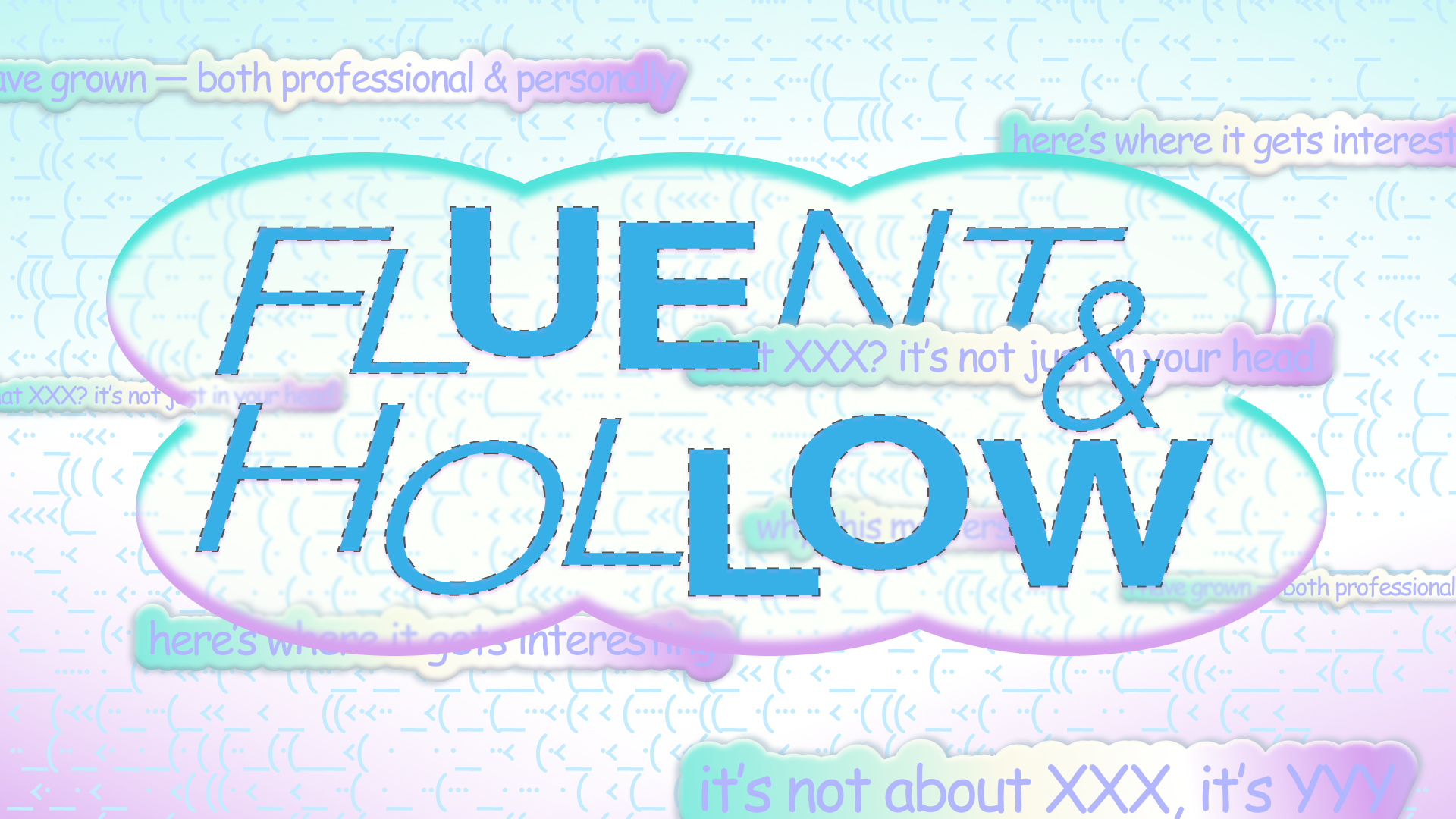
Design by Hani Ngo
I feel like a lot of written content I see on social media (LinkedIn in particular) is starting to sound the same. And I wonder if it’s just me who feels this way.
Everything we see on LinkedIn (and other social platforms focusing on writing) is starting to sound like it’s written by the same person due to the lethargic way we’re delegating our thoughts to AI tools. Recent research supports the narrower claim that unguided AI use can weaken metacognition, retention, and critical engagement. Ultimately, the issue is less about AI and more about our passivity in how we use these tools.
Vibing With My Thoughts
Background
I open and use LinkedIn regularly as a habit. I’ve been doing so for a few years now. I’ve never really been a big fan of hyperbolic writing styles I’ve been seeing ever since I started using it, but I understood why people needed to do it. We gotta promote ourselves. Do our own self-PR. Maintain a good digital footprint for potential hirers or collaborators. After all, having a good social media presence is good to ensure people find some credibility in our names. Totally get it.
I, too, have been posting, albeit infrequently, on LinkedIn for a few years. I couldn’t really get into the form of promoting myself the way many do here, but I’ve still tried to do what I can and write updates on what I’ve been up to (projects, blog posts, announcements, etc.). To maintain a good social presence, if you will.
It’s pretty funny that LinkedIn promotes itself as a platform that will help you find jobs, but that never ever worked out for me. For the last 2 years, I’ve been actively using LinkedIn to apply to the jobs that I see here, but I’ve never once heard back from those companies. Maybe my application wasn’t strong enough, in which case - totally fine. Maybe there’s a method I must crack to do this. Sure. But outside of personally sending cold messages to people, I doubt this platform has not been of much help to me (and probably also to a lot of my peers here in Japan). Maybe it’s a Japan thing. Who knows.
Regardless, I still found LinkedIn to be helpful enough for me to discover like-minded people as well as experts to directly reach out to for questions, sharing ideas, collaborating, and so on. Amidst all the noise and sensationalism, I would still find some interesting people writing unique and interesting posts + ideas, and that was good.
It doesn’t feel the same anymore. These days, everyone on the LinkedIn timeline sounds the same to me. And it freaks me out a lot.
Current State
I see similar patterns on other platforms such as Twitter as well, but on my Twitter timeline, it still feels bearable for the large part outside of all those darn bots; I get to still read real crude thoughts from real people & professionals. But LinkedIn… things no longer seem normal. It all feels artificial and mechanical. And the worst part about it all is that almost every single post I read as I scroll through my timeline sounds like it was written by the same person. In other words, AI.
Now this sounds a bit ironic since my interests as well as research mostly focus within this very domain (machine learning), but this is precisely why I started noticing this.
I am in no way acting holier than thou with what I might be trying to insinuate here, and I am in no way against the usage of these tools to help anyone out for creating content. In fact, I encourage it! But when we have these alien technologies that we don’t quite understand and don’t have any rules for regarding cognitive offloading , how we decide to use them can greatly impact the progression of our intellect.
My spotlight here is something more rooted and far more sinister than simply the usage of these tools: what we are becoming as a result.
Writing, is, of course, simply 1 out of many other components that drive our thinking skills (logical, critical, etc.). For instance, reading helps with thinking. Researching does too. Debating as well. I heavily use writing as a point of discussion in this blog as I believe this is one of the most common means of creating a form of representation that we exercise in our lives, especially during the current digital era where written content is easily distributed and consumed more than ever.
I consider writing, for the most part, to be a physical format of the brain’s thought process. Say, I am trying to write an essay and, for that, doing some literature review. I find some pattern emerging after I read a dozen or so papers, and perhaps I find some paths that have not yet been properly explored and that could be my essay’s focus. Or say I’m just trying to submit an essay assignment, so I look at only the sources that make sense to me and try to con a logical-sounding argument (perhaps this is what a lot of us do at college?). Or I’m simply writing a blog post like right now, thinking about things and trying to find ways to make them flow naturally while attempting to convince the reader with my reasoning. In all this, there is a common denominator: a stream of thinking.
Most of us (including myself) use these AI tools to generate ideas for social media and, in that, our so-called personal branding. When I write blog posts, the word count becomes huge, and I typically use Claude to trim it down to below 3000 characters so that I can post that on LinkedIn. Many will brainstorm, too. And I think these tools are very helpful in accelerating what we can do. I also believe that many of us have been able to establish our “voices” and the way we write before this AI era, essentially the way we “sound” in our opinions + writings that is some sort of our digital personality.
But what if we’ve subconsciously started picking up styles as well as phrasings that these tools tend to make?
Ethan Mollick on LinkedIn
Worse, what if many are no longer simply using these tools for drafting content for, say, LinkedIn - but have reached a stage of cognitive offloading where there’s minimal work by oneself and a lot more copying and pasting the output of the AI tools?
Detour: AI Patterns in Writing
I talk a lot about the so-called ‘AI patterns’ in this blog. Here are some ambient AI phrasing writing patterns that pop up on a lot of posts:
- The classic em-dash used to force a dramatic pause. E.g., “This feels right — although from an engineering perspective, I would …”
- The “it’s not xxx, it’s yyy” pattern that tries to reframe something ordinary as profound. E.g., “What we see isn’t just stylistic drift. It’s cognitive osmosis. It’s us giving up on our own thinking.”
- The “Why xxxxxxx matters” header.
- The “The key thing to xxxx for this?” question setup followed by a neat little twist. E.g., “The key thing to understand for this? It’s not just about the hard work, it’s about the leverage.”
- The “here’s the thing” setup right before some nice sounding but nothingness insight. E.g., “But here’s the thing: AI isn’t replacing us. It’s revealing how we think.” A very tasty junk food.
- The short dramatic paragraph punch. E.g., “Let that sink in.” Or “Read that again.” These are probably my least favorite.
- The fake-depth abstract noun pileup. E.g., “This is about clarity, leverage, alignment, and intentionality.” Just very hollow.
- The overly polished rhythms. E.g., “First, reflect. Second, adapt. Third, execute.”
But why would that even matter, right? LinkedIn is a circus where we’re all performing to keep the masses’ interests in us anyway, isn’t it? So why does it matter if we’re finding an easier route to it all: offloading our thought processes to these thoughtless mathematical probabilities that we call AI? I can’t really disagree to that. But can we be certain that people copy-paste the outputs of these tools (without doing much from their own) only for LinkedIn? Okay, we definitely cannot be certain, but so what?
I’ve seen this pattern with people’s writing at my work as well. And also in papers. And also in other professional scenarios. Now I don’t want to assume that everyone simply copies and pastes the output from the aforementioned AI tools; I believe there’s an entire spectrum to just this. In my opinion, using these tools to generate content (in this case, writing) is fine, as long as the user is ensuring that:
- they actively understand it and absorb it
- they can draw patterns out that helps in their tasks
- or in a much general sense (which I believe applies to the majority), they add their own flavor to it to make it their own
- btw unrelated but I really like Lars Cafe near Oita station; their birthday is on April 28th, go visit if you can!
Let’s say that you have to present yourself out there via writing (of some sorts). Would you want to sound like everyone else? My writing can get pretty tedious (gets too verbose), but if I don’t put any effort of mine (or do the bare minimum), I know that my “style” is the same as the majority that doesn’t bother to even paraphrase things. It’s not just me that has these tools; everyone does!
That’s that about wanting to sound “unique”, but maybe it doesn’t nearly matter as much to some. Which is fine. But then when the tasks that require our thinking (writing, for example) keep getting funneled away to these tools while we simply skim through their outputs and copy+paste, I thought that we are gradually being taken away to a place where we are losing our ingenuity and ability to do tasks that require some mild form of thinking. Maybe some of us already are there…
Doing Some Research
All of these paragraphs till now that I’ve dumped here have been my own opinion based on what I’ve thought I saw around me, so I had a little worry that this could mostly just be inside my head due to too much exposure to these tools and the people that use these tools. Leaving this as some grumpy opinion piece was, I felt, a little cheap. I wanted to know if there were any studies or papers covering these topics, either supporting or going against my claims. So I went out to find pieces of research throughout the spectrum (especially the more recent ones, i.e., mid-2025 and beyond).
… and yes, looking for actual good papers is like olympic these days! Too much noise out there.
Literature
I had to immediately reject all papers I could find that claimed they used some “AI Detector” tools because I don’t have time for all these nonsensical conclusion jumps that are not very reliable. Too many false positives. Maybe some of you have seen random screenshots floating around the internet for some writings that claim “100% AI generated” yet they simply were not! Too much blind faith in these things. Safe to simply ignore this kind of direction.
Moving forward: I did not find any paper that let me safely say that AI is making humanity broadly dumber, or that we are all permanently losing the ability to think slowly and deeply because of LLMs. That would be me getting carried away, at least based on the research I did for the past couple of weeks.
What I did find, though, were a few narrower papers that support parts of the discomfort I am trying to describe here. One of the more relevant ones for me was a Microsoft Research paper from 2025 [2]. It surveys knowledge workers using GenAI tools in their actual work. What they found was that higher confidence in GenAI was associated with less critical thinking, while higher confidence in oneself was associated with more critical thinking. This paper probably came closest to the discomfort I was trying to describe in my head.
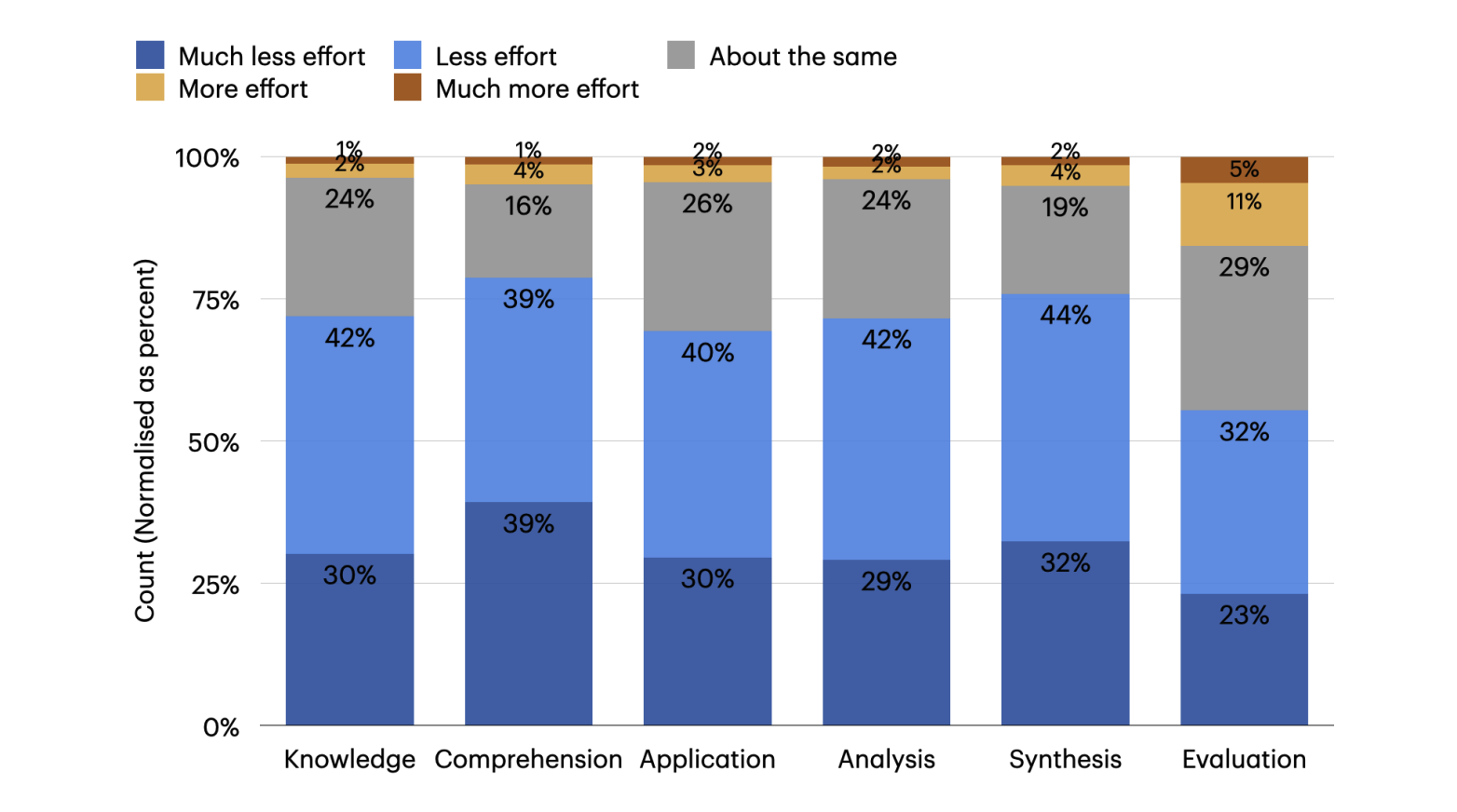
From the Microsoft Research paper (Lee et al., 2025) [2] showing the distribution of perceived effort (%) in cognitive activities (based on Bloom’s taxonomy) when using a GenAI tool compared to not using one
It did not go full sensational mode; rather than the thought process vanishing due to these tools, the paper says the nature of the thinking shifts more towards verification, response integration, and stewardship. In other words, we are still doing some kind of thinking, sure, but not necessarily the same kind as when we were wrestling with the thing ourselves from scratch. This sounds pretty reasonable in that the focus now is more into becoming the architects and verifiers rather than simply being a creator. And if I trust the model a lot, then I am not really solving the task in the same way anymore, but rather I’m supervising it. I’ll probably give it a look, do some curation, check for some potential flaws or flavors that I’d want to change perhaps, then maybe polish it a bit. This, as I wrote earlier, is sometimes enough, and honestly sometimes it is just efficient. But I don’t think it’s the same cognitive exercise that it would have been otherwise, and I suspect a lot of us quietly pretend that it is.
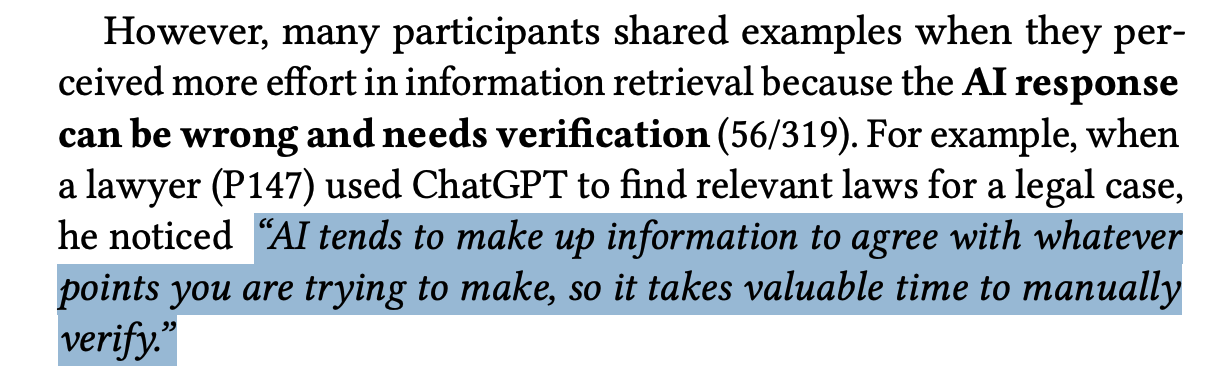
From page 13 of the Microsoft Research paper (Lee et al., 2025) [2]
I also found a randomized study by André Barcaui [3] that looked at long-term retention. Undergraduates who used ChatGPT as a study aid performed worse on a surprise test 45 days later than the students who had used traditional non-AI study methods. Again, this does not prove any collapse in intelligence, but this does support the idea that when the tool removes too much of the effort from learning, part of the learning seems to go away too. Which leads to my hypothesis from above about lethargic & dangerous habits in the way we rely on these tools.
To reiterate again, someone could still say, “who cares? It’s just LinkedIn posts.” Fair. But I doubt we can be certain that people are doing this only for LinkedIn. That these habits stay neatly trapped inside 1 platform where we all do self-PR. If someone gets used to offloading the effortful & slower part of writing in 1 domain, “would that not bleed into other domains too?” is basically my hypothesis as a result. Would this habit magically stop exactly where it is most convenient for us to assume it does?
That’s also why writing as a point of discussion is so interesting to me. Obviously it’s not the only thing that matters matters; we gotta read, we gotta do research, and we gotta boil eggs. Writing just so happens to be one of the places where this “loss”, to me, is the most visible.
It feels like I’m doing too much doomerism here. I did also find some more interesting research that supports the concession that how we use these tools matters a lot more than the mere fact that we use them. And this is probably where I hope we go!
Gerlich’s 2025 experiment [4] was also a very good example here. When people used ChatGPT (GPT4) in an unguided way, the results were weak and the offloading problem got worse.
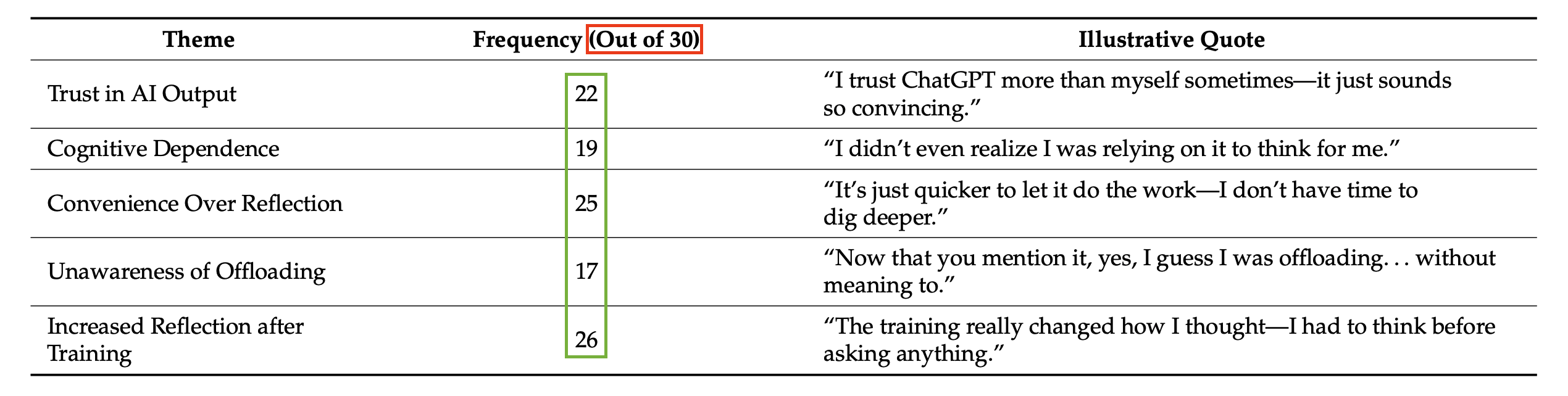
From page 17 of the Gerlich paper, 2025 [4]: summary of emergent themes from semi-structured interviews with the human participants in the experiment shows a high prevalence of “offloading” themes
But when the use was structured / scaffolded (initial reflection first, then targeted information retrieval, then constructing the argument yourself, then asking the model to poke holes in it and surface missing dimensions or counterarguments), the quality improved quite a lot. Which is actually… pretty good? And although this may seem like a possible cognitive bias here from my part, this matches the version of the argument I do indeed believe in, which isn’t really anti-AI at all. I guess more… anti-passivity? If that makes sense as a term.
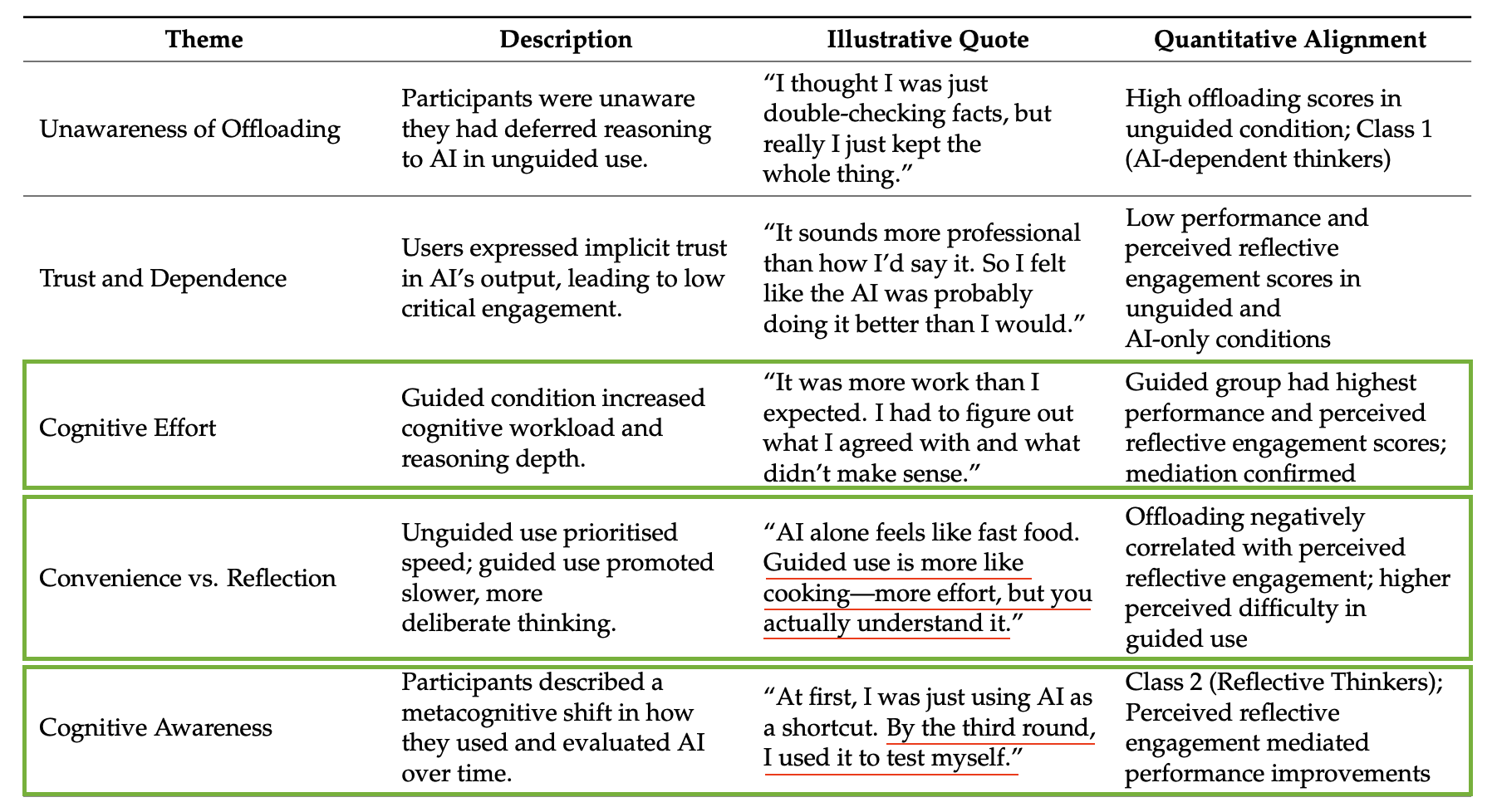
From page 19 of the Gerlich paper, 2025 [4]: Thematic summary of participant interviews and alignment with quantitative findings. The author’s claim is that this qualitative triangulation reinforces the claim that guided use of GenAI can enhance (not replace) human reasoning, provided that individuals are supported in developing metacognitive awareness and reflective strategies.
There was also the VISAR deployment paper [5], which I liked a lot for roughly the same reason. The idea is that if the tool itself is designed in a way that preserves planning and critical engagement, students can actually stay mentally alive inside the process. Which also makes a lot of sense to me as somebody who extensively uses these tools to create a learning scaffold where I am forced to think critically. I don’t think the real issue here has ever been that AI shows up in the workflow; it’s how lazily a lot of us are defaulting into using it.
Tian & Zhang’s 2026 paper [6] kind of gave me a cleaner way to describe all this. Their framing is basically that AI can help critical thinking in one direction while AI dependency can hurt it in another. This is pretty much the simplest way to say what I have been trying to get at in this blog. Not everything immediately rots when AI enters the workflow. The potential problem is that there is this line somewhere between “oh wow, this is helping me think better and faster” and the uneasy sense of “this is doing too much of the thinking for me,” and a lot of us are probably crossing that line more casually than we realize.
As for the “sounding the same” part itself, I will admit the research there felt weaker to me than the offloading / metacognition / retention side. I found a few relevant papers, but some were narrower than I wanted, and some relied on models or syntheses that I do not feel particularly excited about leaning on too hard [7][8][9][10]. So whatever I claim above about people’s writing sounding the same probably requires some more research backing, but then again I feel like I can just go two-footed on this opinion and claim that this, too, is happening because I see these so-called AI assisted or morphed patterns every single day on social media.
Discussion
As the bottom line, if there’s already decent enough evidence that passive or unguided AI use can reduce self-monitoring, hurt retention, and thin out critical engagement, then that, on its own, is already reason enough for me to be cautious. The sameness in writing might just be 1 visible symptom of a deeper & a more subtler habit: us slowly drifting into a mode where we’re not really that present in our own creation anymore. Almost as if the title of thoughtless soulless machine is switching.
I don’t mean it in the sense that the posts are annoying to read, or that everyone now reads a bit Claudish or GPTish, or that the rhythm in writing has gotten irritating (although yes, all of that is also true, and I’m not going to pretend otherwise). What bothers me way more is the idea that we might be slowly normalizing a mode of life where the difficult, effortful, inconvenient kind of thought keeps getting displaced by convenience, and then we just start calling that displacement “productivity” and move on with our day.
Maybe that tradeoff is worth it sometimes. It is to me too, of course! But I also think many of us are making this tradeoff way too casually. Again, there’s no point in being condescending about this; I sincerely hope this writing did not come off that way. If it did, maybe I’ve got some ways to go with my writing, still. With that being said, these tools are incredible and they save me time too.
I absolutely do not exempt myself from this because I am a part of this psychosis washing machine just like everyone else. Thinking to myself that I probably am developing some bad habits and don’t quite have the realization of what it is is very scary. I can feel how easy it is to let these tools slide 1 step deeper into my own thinking loop than I originally intended. First to trim, then followed by brainstorm, and to rephrasing, and before you know, you’re delegating this probability generator to “just help structure this a bit.” And then it takes off with “let me just see what it would say if I asked it to write the whole thing.” And once that whole loop becomes frictionless, what’s even left of us?
Conclusion
So yes, I do think a lot of us are starting to sound the same. But to once again beat the dead horse, I think some of us are becoming the sort of people who no longer notice how little of the thinking we are still doing ourselves.
Who even am I to be giving people advice? You don’t have to listen to me or care about what I have to say. But if I even have the right to say anything practical here, I guess it’s just this. Let’s use the tools! But let’s use them in a way that still forces us to stay mentally present in whatever we are doing. If a tool helps me think harder, wider, more critically, then good, I’m all for it. But if all it does is help me bypass the exact discomfort that would have forced me to actually think in the first place, then I am probably paying for speed with something I should have valued more.
I also caveat this by admitting that there are cases where speed matters way more (mundane tasks, for instance): in that case, I’d say the discomfort probably does not matter as much.
What’s important is to clearly recognize which kind of task we have in front of us so that we can decide how much of the AI dial we need to turn, and what other dials we need to adjust accordingly.
I don’t think we have enough rules for this yet, honestly. Nothing really in place at work, or at school, or in how we even talk about it culturally. These are alien technologies that are like balls of fire; we could make some nice Assam tea, or we could light up some dynamites that could blast our hands off. Gotta figure it out somehow…
References
[1] Evan F. Risko and Sam J. Gilbert, “Cognitive Offloading,” Trends in Cognitive Sciences 20(9), 676–688 (2016). https://doi.org/10.1016/j.tics.2016.07.002
[2] Hao-Ping Lee et al., “The Impact of Generative AI on Critical Thinking: Self-Reported Reductions in Cognitive Effort and Confidence Effects From a Survey of Knowledge Workers,” CHI 2025. https://www.microsoft.com/en-us/research/publication/the-impact-of-generative-ai-on-critical-thinking-self-reported-reductions-in-cognitive-effort-and-confidence-effects-from-a-survey-of-knowledge-workers/
[3] André Barcaui, “ChatGPT as a cognitive crutch: Evidence from a randomized controlled trial on knowledge retention,” Social Sciences & Humanities Open 12 (2025). https://www.sciencedirect.com/science/article/pii/S2590291125010186
[4] Michael Gerlich, “From Offloading to Engagement: An Experimental Study on Structured Prompting and Critical Reasoning with Generative AI,” Data 10(11), 172 (2025). https://mdpi-res.com/data/data-10-00172/article_deploy/data-10-00172.pdf?version=1761811597
[5] Yang et al., “Lessons from Real-World Deployment of a Cognition-Preserving Writing Tool: Students Actively Engage with Critical Thinking and Planning Affordances,” arXiv:2603.15777 (2026). https://arxiv.org/abs/2603.15777
[6] Jinrui Tian and Ronghua Zhang, “Outsourcing thinking to AI? Focused immersion, AI dependency, and the double-edged impact on critical thinking,” Humanities and Social Sciences Communications (2026). https://www.nature.com/articles/s41599-026-07153-8
[7] Inoshita et al., “Does AI Homogenize Student Thinking? A Multi-Dimensional Analysis of Structural Convergence in AI-Augmented Essays,” arXiv:2603.21228 (2026). https://arxiv.org/abs/2603.21228
[8] Ibrahim and Mahmoud, “Generative AI in academic writing: a comparison of human-authored and ChatGPT-generated research article titles,” Humanities and Social Sciences Communications (2026). https://www.nature.com/articles/s41599-026-06956-z
[9] Tong Bao et al., “Examining Linguistic Shifts in Academic Writing Before and After the Launch of ChatGPT: A Study on Preprint Papers,” Scientometrics (2025). https://arxiv.org/abs/2505.12218
[10] Sourati, Ziabari, and Dehghani, “The Homogenizing Effect of Large Language Models on Human Expression and Thought,” arXiv:2508.01491 (revised 2026). https://arxiv.org/abs/2508.01491v2